


Page 91 - ΝUMO 2026
P. 91
FOL LOW  /  My k o n o s  THE SLOW


              CRAFT


              A Mykonos-based artist and

              teacher, Irene Syrianou works with
              mosaic as a medium of memory,

              transforming fragments into quiet,
              enduring narratives.

              Interview by Despoina Sampson


                            Irene Syrianou is a mosaic artist based in Myko-  the tesserae, that were missing seemed to speak almost louder
              nos, where she has maintained her workshop and retail space   than those that remained. That was when I understood that
              near the waterfront since 2001, while also offering hands-on mo-  this art is not only about image. It is about memory.
              saic lessons to visitors and locals alike. In a place often defined   Your work moves between the reproduction of ancient motifs
              by surface, speed, and spectacle, she stands quietly apart, not as   and contemporary creation. How do you balance tradition
              a figure of the island’s luxury façade, but as a creator rooted in   with personal expression?
              its deeper layers. Raised between Mykonos and Delos, she car-  Tradition is an old path. I follow it, but I never walk exactly in
              ries within her a lived connection to the Cycladic landscape and   the same footsteps. Each piece is a small deviation, a personal
              its history. Her work draws directly from this proximity: from years   route within something that existed long before me.
              spent among the ancient mosaics of Delos, from the discipline   You continue to cut each tessera by hand, following an ancient
              of restoration, and from a practice grounded in patience and   technique. What does this process mean to you in an industri-
              handwork. Each tessera she uses is cut by hand, one by one,   alized world moving at the speed of Artificial Intelligence?
              continuing  a  tradition  that  resists  speed  and  automation.  For   Each tessera cut by hand carries a sound, a rhythm. It is a slow
              more than two decades, she has also been teaching—both in   act, almost stubborn, within a world that is always in a hurry.
              her workshop and across remote islands of the Cyclades and   Somewhere between those small fragments, I find a way to
              the Dodecanese—passing on not only a technique, but a way   concentrate and to lose myself at the same time.
              of seeing. Her mosaics, whether contemporary compositions or   Teaching seems to be a central part of your journey, from
              ancient-inspired works, are built from fragments, from materials   your workshop in Mykonos to schools on remote islands.
              once discarded, reassembled into something enduring. In Myko-  What would you like your students, and visitors, to take away
              nos, Irene Syrianou represents a different kind of narrative; one   from this experience, rooted as it is in the reuse of materials?
              rooted not in display, but in continuity.               I don’t want to show my students only how to make a mosaic.
              You spent ten years on Delos, surrounded by ancient mosa-  A mosaic is born from what is left behind—from fragments, from
              ics. Was there a specific moment when you felt this art truly   materials that once had another life. Slowly, both students and
              touched you?                                            visitors begin to discover this. And then the way they look at it
              I am, in many ways, what you would call a village girl. I was   changes. They no longer see just an image, but a second chance.
              raised within an agricultural family between Delos and Myko-  What do you dream of capturing in mosaic?
              nos, close to the land and its rhythms. I first encountered my   I carry within me many images that never became works. Time
              craft when I spent a period working among the antiquities of   always slips away. There is never enough of it. And yet, the
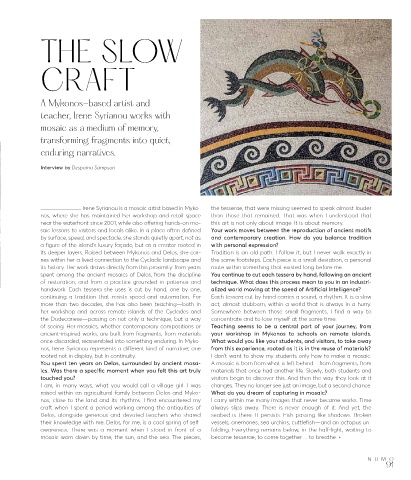
 A mosaic artist rooted in Mykonos and Delos,   Delos, alongside generous and devoted teachers who shared   seabed is there. It persists. Fish passing like shadows. Broken
 shaping memory through fragments.
              their knowledge with me. Delos, for me, is a cool spring of self-  vessels, anemones, sea urchins, cuttlefish—and an octopus un-
              awareness.  There  was  a  moment  when  I  stood  in  front  of  a   folding. Everything remains below, in the half-light, waiting to
              mosaic worn down by time, the sun, and the sea. The pieces,   become tesserae, to come together… to breathe. •


 N U MO                                                                                                                  N U MO
 90                                                                                                                            91

