


Page 87 - ΝUMO 2026
P. 87
FO L LOW / C o rf u


 EASTERN


 WORLDS


 In the historic centre of this verdant Ionian island,

 the Museum of Asian Art of Corfu bridges the
 surrounding landscape with distant artistic and

 philosophical traditions, offering an experience unlike
 anywhere else in the country.

  Corfu has always existed at a crossroads. Not only of empires   capture  gesture,  movement,  and  fleeting  emotion  with  remarkable  clarity.
 and influences, but of atmospheres, where the Ionian light meets something   Further on, sculptures from India and Gandhara introduce a more introspec-
 more inward, more contemplative. It is within this quiet duality that the Mu-  tive dimension. Here, the convergence of Hellenistic and Buddhist traditions
 seum of Asian Art of Corfu reveals its singular presence. Housed in the Palace   feels unexpectedly coherent, a reminder that cultures have always been in
 of St. Michael and St. George, the museum carries a sense of continuity rather   dialogue, even across distance. Bronze Buddhas, serene yet present, coexist
 than contrast. The Regency symmetry of the building, once aligned with British   with thangkas from Tibet and Nepal, their intricate compositions inviting pro-
 authority, now holds within it a different kind of power. Even before encounter-  longed attention. From Cambodia and Thailand, sculptural forms trace the
 ing the collections, the experience begins with space itself. Colonnades, high   spread of Buddhism through subtle variations of expression and form, while
 ceilings, and ceremonial halls introduce a rhythm that prepares the eye to   Central Asian textiles quietly echo the rhythms of nomadic life.
 slow down and observe. This is the only museum in Greece devoted entirely to
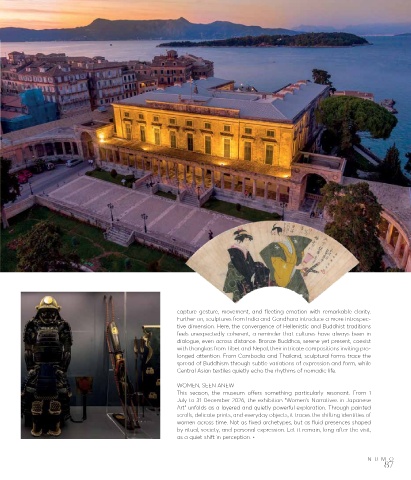
 the arts of Asia, yet its uniqueness lies less in exclusivity and more in its abil-  (From top left) View of the Palace of Saint   WOMEN, SEEN ANEW
 ity to shift perception. Moving through its rooms is a gradual recalibration of   Michael and Saint George: the reception   This season, the museum offers something particularly resonant. From 1
 hall. Woman’s blue khalat (coat) Bukhara,
 pace. Time stretches. Detail begins to matter. In the Chinese collections, his-  Uzbekistan, end of 19th century. Chinese   July to 31 December 2026, the exhibition “Women’s Narratives in Japanese
 tory unfolds almost like a continuous breath, from prehistoric traces to refined   Collection: Roof ornaments with mythical   Art” unfolds as a layered and quietly powerful exploration. Through painted
 imperial eras. Porcelains, funerary objects, and figurines carry a quiet author-  creatures. Japanese collection: Noh   scrolls, delicate prints, and everyday objects, it traces the shifting identities of
 ity, where craftsmanship becomes a form of philosophy. Nearby, Japanese   Masks (Right) Japanese collection: A suit   women across time. Not as fixed archetypes, but as fluid presences shaped
 byobu screens open like suspended narratives. Gold-leaf surfaces dissolve   of samurai armor on display. Fan painting   by ritual, society, and personal expression. Let it remain, long after the visit,
 depicting Kabuki actors -Colour on paper.
 into landscapes and intimate scenes, while woodblock prints and ceramics   Artist: Tōshūsai Sharaku (fl. 1794-1795).  as a quiet shift in perception. •


 N U MO                                                                                                                  N U MO
 86                                                                                                                           87

